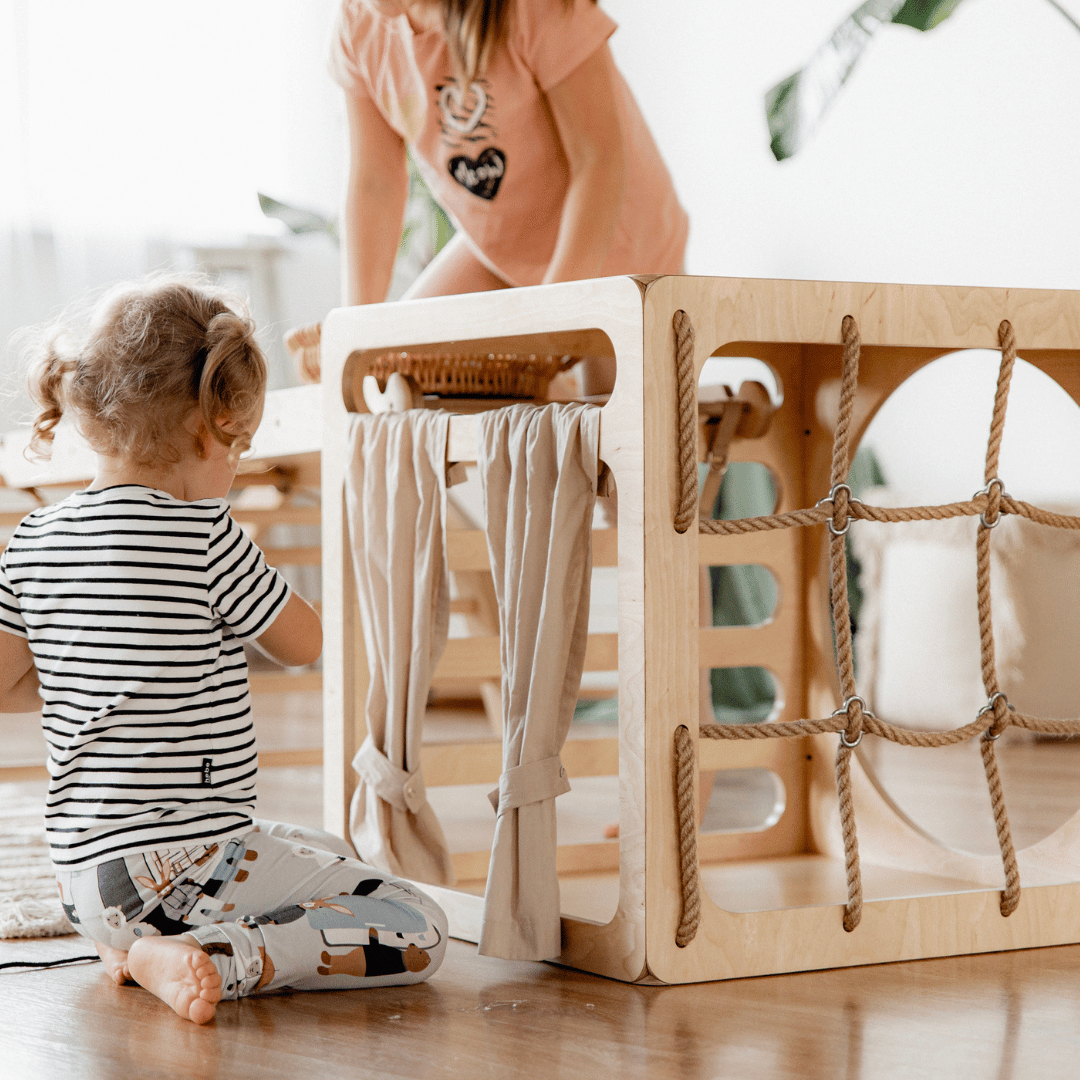
Montessori play that develops and entertains
Growing and learning through play – that’s exactly what a well-thought-out toy world can offer. The Montessori method is about creating environments and tools where the child is given the freedom to explore – while the materials are carefully selected to support learning, motor skills, concentration and independence. When you choose toys with this in mind, you help your child to:
- Train motor skills – both gross and fine motor skills.
- Develop the ability to focus, solve problems and think creatively.
- Feel involved and independent – experience pride in your own achievements.
- Have fun! Because play is not just about development – play is about joy, freedom and creativity.
Below I highlight some selected educational toys from our range, with concrete examples of how they support the child's development - and how they also become a favorite in the playroom. Each product is linked directly to create traffic and facilitate purchases.
1. Climbing cube: CUBITRI® Climbing Play Cube With Rope Window
This climbing cube is more than just a climbing frame – it is inspired by both Emmi Pikler and Montessori pedagogy. Here, the child has the opportunity to explore their body, practice balance, strength and motor skills – while giving their imagination free rein.
Being able to climb, crawl through a tunnel, use rope windows and construct your own games provides several levels of learning:
- Gross motor skills: climbing, balancing, discovering height and depth.
- Coordination: hand-foot interaction, grip and body control.
- Creative play and role-playing: the cube can become a fort, house, tunnel – whatever the child comes up with.
- Independence: the child takes initiative, builds their own play – not just follows instructions.
For you as a parent or educator: place the cube in a room where the child has freedom – while creating security by securing the surface and providing encouragement. By linking to the product, you make it easy for interested parties to follow along from inspiration to action.
2. The Stacking and Sorting Rings: Montessori Toy Rings
As the child grasps, sorts and stacks rings of different sizes, fine motor skills and logical thinking are trained – exactly what the Montessori ideas are about: letting the child discover at their own pace. The product page describes, among other things: “by grasping, stacking and sorting, the child trains their fine motor skills, coordination and understanding of size and shape.
The advantages are many:
- Fine motor skills: grasping, holding, placing.
- Concepts such as size, order, sequence – early mathematical thinking.
- Independence: the child tries, fails, tries again – without any adult saying “do this”.
- Simple but engaging play – perfect as first toy experiences.
Tip: Have the rings in front of you so that your child can choose them when they feel like it. The parent can observe, but let the child control how they are used.
3. The Learning Tower: Montessori Learning Tower, Kitchen Helper – Louis
A learning tower is a fantastic bridge between everyday life and play – it allows the child to join in at the kitchen counter and participate in activities that were previously only available to adults. The product page states: “Encourages independence and motor development.
By standing at the right height and being able to participate in cooking or crafts, the child gets:
- Feeling involved – a huge step towards independence.
- Practice balance and posture by standing steadily.
- Practicing practical life skills – a central part of the Montessori philosophy: “helping life itself”.
- Mutual interaction – the child and adult can work side-by-side.
Here's a blog tip: describe a typical "kitchen time" with the child in the tower - how you bake together, stir, taste, and then the child gets to pour the ingredients or stir the batter themselves.
4. Multifunctional climbing and drawing set: Montessori Climbing Set / Table / Drawing Board NABU
This product combines climbing, table/drawing surface and storage – an example of how the play space can be designed with maximum flexibility for the child's exploration.
Why it's especially Montessori-friendly:
- The child can choose between active play (climbing) and calmer activities (drawing).
- The surface becomes interactive – draw and erase, create and discover.
- The design is resettable – encouraging rebuilding and problem solving.
- From 1 year and up – grows with the child and becomes a long-term investment.
Blog idea: You can describe how this set “grows with the child” – at first they climb with support, soon they draw, later they build their own “workshop”. This creates a story that is suitable for both parents of young children and preschools.
5. The classic: Pikler Triangle Climber with Swedish Wall Add-On (Ages 6m–7y) – Rainbow
Here we have a classic in Montessori/Pikler play – the triangle combined with a wall part, for the sake of play and movement. The product page states, among other things: “Develops dexterity, balance and coordination… Encourages imaginative play and increases self-confidence.
These are some concrete benefits:
- Movement and physical development – climbing, crawling, balancing.
- Exploration – the child tries new paths, is challenged at their own pace.
- Safe indoor play – for when weather or space is limited.
- Aesthetic design – makes the toy fit into the home and become a part of everyday life.
A blog tip: paint the scenario “from first grip at 6 months to willing climber at 3–4 years” – how play develops and how parents can support without taking over.
Summary – Keys to Choosing the Right Montessori Toy
When writing parents or educators: highlight this:
- Choose toys that support independence – the child can explore on their own, within a safe framework.
- Look for materials with open-ended play – not ready-made assignments, but opportunities.
- Focus on motor skills , sensory skills , creativity – all parts of children's development.
- Think long-term – many Montessori toys grow with the child and become investments.
- Create an environment where play and learning go hand in hand – and where both children and adults have fun.
In conclusion: Play is not just “fun while it lasts” – from a Montessori perspective, it is a gateway to learning, growth and self-confidence. By linking to the Products above, you make it easier for interested parties to take the step from inspiration to purchase via Auréz Kids.